By Elizabeth Robson and Siân Jones
“I never say I come from Aberdeen, I say I come from a little village called Fyvie in Aberdeenshire and the number of people who know about the Fyvie Castle!” (interviewee #5)
“I love the castle, I’ve grown up with it, with country walks and bike rides […] mum used to always take us round here for picnics” (interviewee #4)
The first pilot assessment that we have completed is that for Fyvie Castle, Gardens and Estate. This proved to be a really interesting and rich assessment, with a mixture of overlapping interests, values, and activities associated with different aspects of the property. These ranged from longstanding, multi-generational connections to and memories of the Castle and Estate, to everyday, routine practices that generate an intimate familiarity with the surrounding environment. One of the more unexpected findings was the relatively wide geographical spread of people who consider Fyvie to be their “local castle” or feel a sense of moral ownership of the Castle or grounds, including the strong connections expressed by members of the Clan Forbes Society who were visiting from Canada and the USA.
In this post we provide an overview of the assessment process and summarise some of the key findings. If you would like to know more, a link to access the full report is given below. This work is of particular interest now, as the Trust is embarking on an ambitious project at Fyvie Castle, Gardens and Estate that aims to protect and transform the property and how people engage with and experience it.


Fyvie Castle during the August 2024 Heritage Weekend and the walled gardens in summer (right). Photo credits: Elizabeth Robson.
Fyvie Castle is located a mile outside the village of Fyvie in rural Aberdeenshire. The property came into the Trust’s care about 40 years ago and consists of multiple listed buildings, including the turreted Castle (with contents), set within a designed landscape with formal and walled gardens, woodland, and a lake. The social values assessment aims to understand the meanings, memories, stories, experiences, and feelings associated with the property by people today, and the ways in which these contribute to people’s sense of identity, belonging, and place.
We made several trips to Fyvie during 2024, starting with our joint participation in a one-day symposium on the property Research Strategy (March). Thereafter, Liz undertook a three-day orientation visit (May), during which she liaised with property staff, including the Community Engagement Officer, followed by two week-long research trips (August and December). Visiting repeatedly over an extended period allowed us to build an understanding of the context and co-ordinate with other activities that were happening alongside the assessment process.
Assessment activities included the core methods of interviews, observation, and participant observation. Liz’s research trips were scheduled to coincide with major public events at Fyvie, namely a Heritage Weekend, which included historical reenactors and craft stalls and took place mostly outside, and a Christmas Fair with local artists and craftspeople, which took place inside the Castle. These events provided focused opportunities to engage some of the many hundreds of visitors in rapid, participatory methods. At the Heritage Weekend, we asked the open question ‘what does Fyvie mean to you?’ and gathering responses on sticky notes. At the Christmas Fair, people were invited to create a ‘postcard from Fyvie’, choosing or suggesting images that best captured what was important or special about the property to them. Both of these methods generated a wide range of responses and complemented the other activities.
In total, 118 people directly participated in the assessment activities. Of those, 82 people were engaged in relatively quick interactions during the public events described above, and the rest took part in either questionnaires/structured interviews, longer semi-structured interviews, or group discussions. Some of the semi-structured interviews also included walks around the property and surrounding area, with the route determined by the participant.
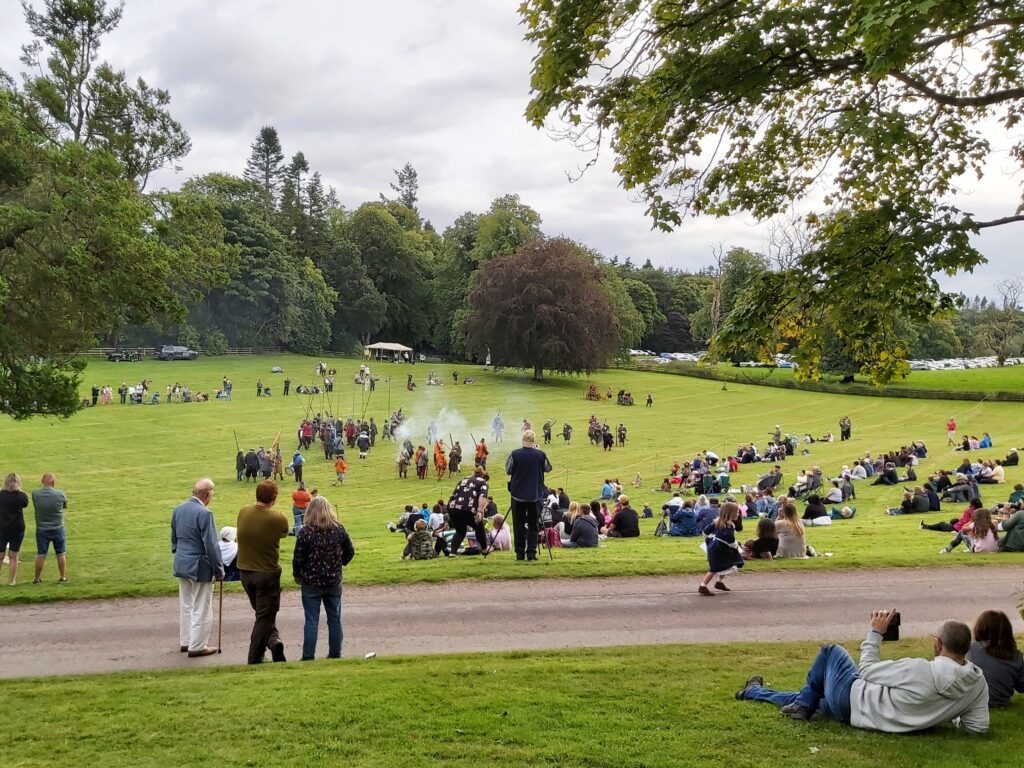

Visitors watching an historical reenactment during the August 2024 Heritage Weekend (left) and the participatory ‘postcard from Fyvie’ activity at the December 2024 Christmas Fair (right). Photo credits: Elizabeth Robson.
Some of the key findings from the assessment are:
- The Castle is a focal point within the estate and a distinctive local landmark – “think of Fyvie and you think of the Castle” (survey #1). However, the building and its contents, while recognised as special and a key part of the attraction for visitors, are not necessarily the primary focus for local people’s values or attachments. People are proud of the Castle, but this assessment found the social values and relationships associated with the natural environment to be more extensive than those related to the domestic interiors.
- The outdoor landscape and gardens are an important focus for community activities and values derived from social, emotional and sensory experiences – “I really like walking here, it is peaceful and calming. I love all the nature, birds, wildlife, and squirrels” (survey #4). People connect with the property through observation and knowledge of the flora and fauna and its seasonal changes – “The smell of the wild garlic, you think ‘winter has gone’” (interviewee #4). The woods and trees structure the landscape, influencing people’s sense of place and providing a focus for commemorations.
- The domestic interiors are the focus of social values relating to identity and belonging for a smaller range of people (notably those with familial or personal connections to the Castle) – “[it is] nice to go somewhere you feel is yours” (Clan Forbes Society member).
- There is an everyday quality to many people’s interactions with the property, which is valued for its associations with people’s life stories – regular routines and familiar locations, experienced and remembered – whether directly or through inter-generational connections. – “My grandma worked in the kitchens and my grandpa was in the gardens in 1920s” (interviewee #2); “I have walked round it so often with grandchildren as they have grown up – it holds loads of happy memories” (survey #11).


Wild garlic flowering along the footpath beside the lake (left) and family photographs in the Morning Room of the Castle (right). Photo credits: Elizabeth Robson.
Fyvie is valued by multiple communities, with attachment not limited to those living nearby or visiting regularly. Many of the intangible emotional attachments, sensory experiences, and memory-based meanings and practices (like picnics, commemorations, and attending to the local wildlife) are not readily apparent or evident in the tangible fabric and are therefore vulnerable to disruption/loss. The varied social values and diverse communities identified also highlight that changes in presentation, access, or use bring the potential for conflict, due to the multiple forms of knowledge, claims to moral ownership, and ways of relating to the property. Going forward, an approach that acknowledges and directly engages with potential value conflicts is likely to be the most productive.
This is the first completed report from the social values project pilot studies. In this and all cases we will be considering the practical implications through collaborative discussions with the property team and other colleagues within the Trust. These discussions will provide a basis for the third phase of this project, when we will return to organisational-level discussions.
If you would like to read the full Social Values Assessment Report for Fyvie Castle, Gardens and Estate, you can access it here (see the files tab). We are very grateful to everyone who shared their time and knowledge with us during the assessment process, including Trust staff and volunteers, local residents, regular visitors, and members of more dispersed communities of interest. Our findings reflect the discussions we had with people at the time. As noted in the report, there are some gaps in who we were able to engage in the process, and the on-going conservation works at Fyvie may also impact on people’s values. For these reasons, we suggest a periodic review of these findings would be advisable, taking into account the evolving context and the opportunities this offers.